The Soul of Coimbra: A Family’s Passage Through Time
Coimbra
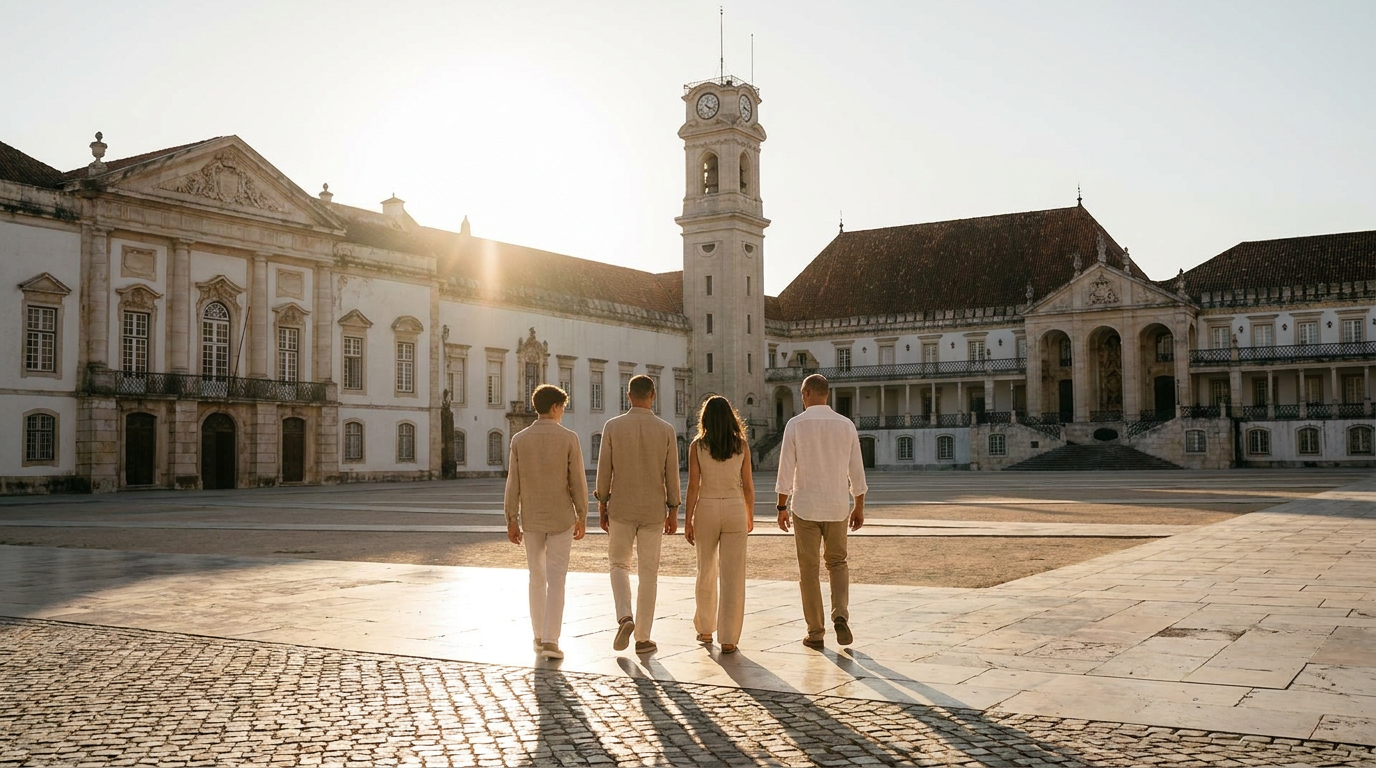
For a family from Chicago, a day spent exploring Portugal’s most storied university city became a lesson in history, not from a book, but from the ancient stones themselves.
An Arrival in Quiet Style
The transition from Porto is seamless. For the Miller family, parents Mark and Susan and their two teenagers, Leo and Chloe, the morning journey south unfolds in the hushed comfort of a black Mercedes-Benz V-Class. The landscape shifts, the energy changes, and soon, Coimbra appears, a city crowned by its university, rising proudly above the gentle curve of the Mondego River.
Their private driver, a man named Diogo with a historian’s knowledge and a local’s warmth, navigates the approach. He does not offer a scripted tour, but rather context, pointing out the ‘upper’ and ‘lower’ towns, explaining the city's lifeblood, its students, before gliding to a stop at the foot of the university’s formidable hill.
The University’s Embrace
To ascend to the University of Coimbra is to walk through a portal. The family steps out into the Pátio das Escolas, the grand ceremonial courtyard, and a collective hush falls over them. The air here feels different, heavy with centuries of academic pursuit and youthful ambition. The scale of the place, the stark white of the clock tower against a brilliant blue sky, the sheer weight of its presence, is palpable.
Even the teenagers, who had been quietly engrossed in their phones for part of the drive, are now captured. They trail their hands along cool stone walls, their eyes tracing the ornate details of the main buildings. It is a world away from Chicago.
"It’s one thing to see these places in a history book, but to stand here… you can almost feel the centuries," Mark murmurs, watching his children. "They are silent, just taking it all in. That’s a win."
[object Object]
A Library of Whispers
The undisputed heart of the old university is the Biblioteca Joanina, the magnificent Baroque library. Upon entering, the scent is the first thing to register. It is a rich, complex perfume of old wood, aged leather, and centuries of paper. Gilded columns twist towards elaborately painted ceilings, and walls lined with more than 60,000 ancient tomes stand as silent witnesses to the passage of time.
The family moves slowly, respectfully, through the interconnected halls. They learn about the colony of bats that has protected the books from insects for centuries. It's a detail of organic history that feels more like magic than science, a perfect encapsulation of Coimbra's unique character.
Echoes in the Alleys
The journey down from the university is a delightful labyrinth. Diogo had suggested they simply wander, and they follow the pull of gravity through the narrow, steep lanes of the old quarter. Whitewashed houses stand shoulder to shoulder, their flowerpots adding splashes of color. They pass by the ‘repúblicas,’ historic student fraternities, their balconies draped with the iconic black capes of the university students.
This is where the city feels most alive. The ancient and the modern coexist, the echoes of medieval footsteps mingling with the distant sound of a student’s guitar.
"Our driver was wonderful," Susan notes later. "He suggested we wander down this specific alley for lunch. We never would have found the little family-run restaurant on our own, and it was perfect, completely authentic."
[object Object]
The Sound of Longing
As the afternoon light begins to fade, another of Coimbra’s treasures reveals itself. From a small square, the distinct sound of a Portuguese guitar emerges, followed by the deep, melancholic voice of a young man. It is Coimbra Fado, a style unique to the city, traditionally sung only by male students.
The family pauses, drawn to the mournful beauty of the melody. It isn’t a performance for tourists, but a raw, heartfelt expression, a tradition passed down through generations. The song speaks of ‘saudade,’ that untranslatable Portuguese feeling of longing, and in that moment, under the setting sun, it feels like the very soul of the city is singing to them.