The Filigree Trail: A Private Journey into the Heart of Portugal’s Golden Craftsmanship
By Portugal Magik · Published 2026-04-04
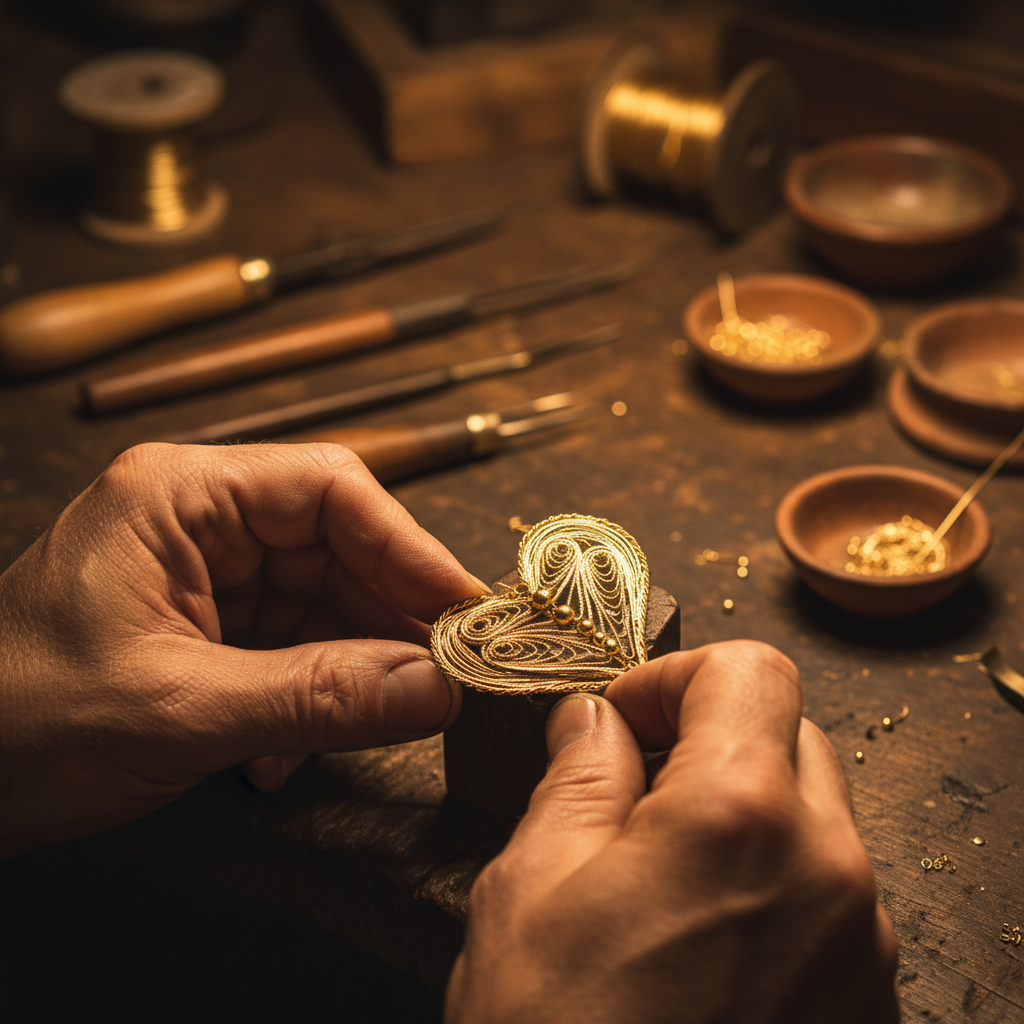
Discover the ancient art of Portuguese filigree on a private journey through Gondomar and Viana do Castelo. Explore the workshops of master artisans and the history of this delicate gold-weaving craft.
The soft, rhythmic tapping of a goldsmith’s hammer echoes through the granite-lined streets of Gondomar, a sound that has remained constant for centuries. Here, in the verdant outskirts of Porto and the rolling hills of the Minho region, an ancient alchemy persists. Filigree, the delicate art of weaving gold and silver threads into lace-like patterns, is more than jewelry; it is a repository of Portuguese soul, a testament to a heritage that dates back to the pre-Roman era.
For the discerning traveler, the Filigree Trail is not merely a shopping excursion. it is a deep immersion into an artistic legacy that requires extraordinary patience, precision, and an intimate understanding of precious metals. Traveling this path with a dedicated private guide allows for a level of access typically reserved for historians and serious collectors, bridge-building between the modern world and the quiet workshops where time seems to stand still.
## The Ancestry of Gold: A Legacy Woven in Thread
The story of Portuguese filigree is intertwined with the nation’s age of discovery and its deep-rooted religious traditions. While the technique itself was brought to the Iberian Peninsula by the Phoenicians, it was the Portuguese who refined it into a distinct regional identity. The iconic *Coração de Viana* (Heart of Viana), with its distinctive "cornucopia" top, is perhaps the most recognizable symbol of this craft, representing the Flame of the Sacred Heart and a profound devotion to the divine.
Unlike mass-produced jewelry, authentic filigree is entirely handmade. The process begins with melting the gold or silver, which is then drawn through progressively smaller holes until it becomes a wire as fine as a human hair. Two of these threads are twisted together and flattened to create a serrated edge that catches the light like a constellation. In the hands of a master *filigranista*, these threads are shaped into intricate motifs, flowers, hearts, and scrolls, and soldered with a precision that defies the naked eye.
## Gondomar: The Capital of the Craft
The journey along the Filigree Trail begins in Gondomar. Located just east of Porto, this city has been the heart of Portugal’s gold-working industry for generations. To walk through Gondomar is to witness a community where every second household once housed a small atelier.
While many of the larger factories have modernized, the true magic lies in the smaller, family-owned workshops. Here, premium experiences curated for international travelers offer the rare opportunity to sit beside a master artisan. Under the soft glow of a workbench lamp, one can observe the "filling" process, a mesmerizing dance where tiny segments of wire are placed inside a sturdier gold frame.
### The Filigree Museum
A stop at the Municipal Filigree Museum in Gondomar provides the necessary historical context. Housed in a beautifully restored manor, the museum showcases historical pieces that display a level of detail almost impossible to replicate today. It serves as an essential introduction before heading deeper into the Minho region to see the craft in its most traditional setting.
## Viana do Castelo: Where Gold Meets Tradition
As you travel north in the refined comfort of a high-end Mercedes-Benz vehicle, the landscape shifts into the lush, emerald greens of the Minho. Your destination is Viana do Castelo, a coastal city where filigree is not just an ornament but an essential component of the local identity.
If you happen to visit during the *Romaria de Nossa Senhora d’Agonia* in August, you will witness the "Stewardship Parade," where hundreds of women dress in traditional red and black costumes, their chests draped in layers of heavy gold filigree. This display of "family gold" is a proud statement of heritage.
Outside of festival season, the experience remains equally profound. Private visits to local "Casas de Ouro" (Gold Houses) reveal how these pieces are passed down from mother to daughter, each one carrying the stories of the women who wore them before. It is here that one truly understands why filigree is considered a "living art."
## The Art of Curation: Selecting an Original Piece
For many, the climax of the Filigree Trail is the acquisition of a personal heirloom. However, in an era of globalization, discerning the authentic from the industrial is vital.
Authentic Portuguese filigree must be certified. High-end ateliers provide documentation ensuring that the piece was made using traditional methods and genuine precious metals. When selecting a piece, look for the density of the threadwork and the cleanliness of the soldering. A truly premium piece feels feather-light despite its intricate appearance, a paradox achieved only through the mastery of the fine-thread technique.
### Customizable Experiences
The true beauty of a private journey is the ability to customize the itinerary based on your interests. For those with a penchant for design, we can arrange private audiences with contemporary designers who are reinventing filigree for the 21st century, blending traditional lace-work with modern, minimalist geometries. This fusion ensures that the craft remains relevant for a global audience while honoring its ancient roots.
## Navigating the Trail with Portugal Magik
Exploring the heart of Portugal’s golden craftsmanship requires more than just a map; it requires a bridge to the local culture. At Portugal Magik, we have spent 14 years refining the art of travel, ensuring that our guests experience the most authentic and exclusive facets of our country.
Our fleet of premium Mercedes-Benz vehicles, ranging from the elegant E-Class to the spacious V-Class and Sprinter, provides a sanctuary of comfort as you move between the workshops of Gondomar and the historic plazas of Viana do Castelo. Our professional English-speaking drivers are more than just chauffeurs; they are sophisticated hosts who understand the nuances of the Filigree Trail and the importance of a seamless, high-end experience.
Traveling with us means you are not a mere observer of the craft. You are a guest in the inner sanctum of Portuguese artistry, enjoying a journey that is as meticulously crafted as the gold threads themselves.
## Essential Information for Travelers
* **Best Time to Visit:** While the Filigree Trail can be experienced year-round, the late spring and summer months offer the most vibrant atmosphere in the Minho region. * **Location:** The primary hubs are Gondomar (15 minutes from Porto) and Viana do Castelo (1 hour from Porto). * **Authenticity:** Always look for the “Filigrana de Portugal” certification mark to ensure the piece is handmade using traditional techniques. * **Private Access:** Many of the most prestigious workshops are not open to the general public. Access is best coordinated through a dedicated travel partner to ensure a private and personalized reception.
## A Golden Conclusion
The Filigree Trail is a journey of discovery, where the shimmer of precious metal reflects the resilience and creativity of the Portuguese people. It is an invitation to slow down, to appreciate the value of human touch, and to bring home a fragment of history that will remain timeless.
As you consider your next journey to Portugal, imagine a day spent uncovering these hidden treasures, guided by experts who value sophistication and authenticity as much as you do. The gold of Portugal is waiting to tell you its story.
Speak with our team and discover how to turn this experience into reality.