Ceramic Swallows on the Wall: Portugal’s Fondest Home Good-Luck Charm
By Portugal Magik · Published 2026-11-15
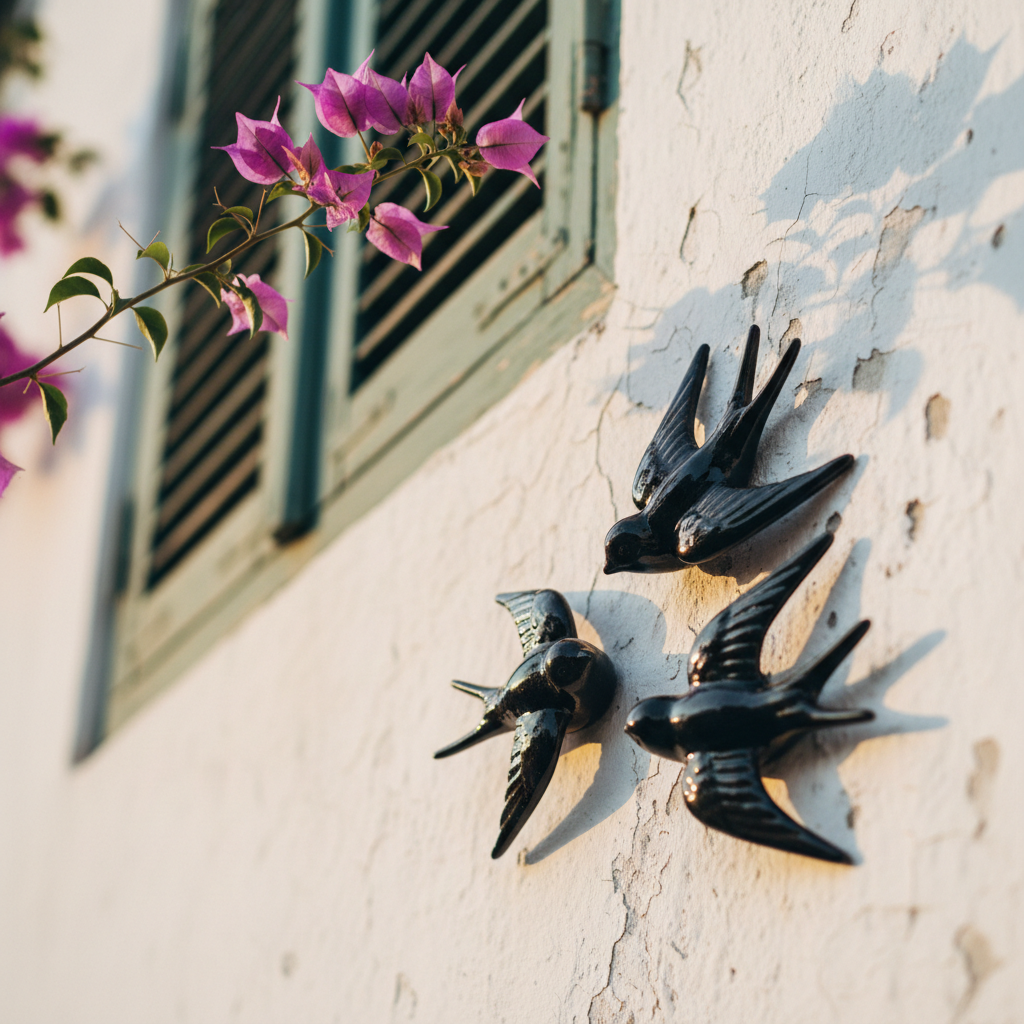
Discover the story behind Portugal's ceramic swallows, a beloved symbol of family, loyalty, and home that decorates walls across the country.
As you stroll through the sun-drenched streets of Lisbon or the whitewashed alleys of Alentejo, you will notice a recurring motif perched on the eaves of houses and decorating the entrances of local shops. Small, dark birds with spread wings appear to be in mid-flight against the pastel walls. These are the *Andorinhas*, the ceramic swallows that have become the unofficial soul of the Portuguese home.
In Portugal, these birds are much more than a simple souvenir. They represent a deep-seated cultural belief in loyalty, family, and the safe return of those who travel. For a country with a long history of explorers, sailors, and emigrants, the swallow is a powerful symbol of the heart always finding its way back to where it belongs.
## The Story of Rafael Bordallo Pinheiro
The tradition of the ceramic swallow began in the late 19th century with a man named Rafael Bordallo Pinheiro. He was a visionary artist, a caricaturist, and a master of ceramics who founded a famous factory in Caldas da Rainha. In 1891, he designed the first set of ceramic swallows, capturing their graceful silhouette in a way that felt both lifelike and artistic.
Bordallo Pinheiro’s factory became a hub of creativity, and his swallows quickly flew off the shelves. People fell in love with the glossy black glaze and the elegant curve of the wings. What started as a piece of decorative art soon transitioned into a cultural phenomenon. Today, the factory in Caldas da Rainha still produces these birds using traditional methods, keeping the legacy of the nineteenth-century master alive.
## A Symbol of Loyalty and Home
Why the swallow? In the natural world, swallows are remarkable birds. They are monogamous, choosing a single partner for life. Every year, they migrate thousands of miles to escape the winter, yet they almost always return to the exact same nest they left behind. This behavior struck a chord with the Portuguese people.
For many locals, hanging a pair of swallows outside the front door is a sign of a happy home. It signifies that the residents are loyal to one another and that the house is a sanctuary of love. Because the birds return to their nests, they are also seen as a good-luck charm for travelers. Families often give them as gifts to those moving abroad or starting a new life, a gentle reminder that the door is always open and their place in the family is secure.
## The Beauty of the Craft
While the original swallows were deep black, today you can find them in every color of the rainbow. In shops across the country, you will see them in vibrant blues, earthy greens, and even shimmering gold or white. They come in various sizes, from tiny specimens the size of a thumb to large, dramatic birds with a wide wingspan.
The texture is what makes them special. When you hold a high-quality ceramic swallow, you can feel the coolness of the clay and the smoothness of the glaze. They are usually designed with a small hole in the underside, making it easy to hang them on a nail. Seeing a flock of them "flying" across a terrace wall in the afternoon light is one of the most quintessential sights in Portugal.
## Finding the Best Swallows in Portugal
If you are looking to bring a piece of this tradition home, there are several places where the craftsmanship is particularly noteworthy. While they are sold everywhere, seeking out authentic ceramicists adds a layer of depth to the experience.
### Caldas da Rainha Located about an hour north of Lisbon, this town is the undisputed capital of Portuguese ceramics. It is the birthplace of the Bordallo Pinheiro brand. Visiting the town allows you to see the original inspiration for the swallows. You can visit the shop associated with the factory and see a vast array of designs, from the classical black swallow to contemporary interpretations.
### Lisbon’s Traditional Shops In the historic neighborhoods of Alfama and Mouraria, many small boutiques and traditional dry goods stores (known as *mercearias*) pride themselves on selling locally made ceramics. Look for shops that emphasize handmade pieces rather than mass-produced plastic versions. The weight and the depth of the color are usually good indicators of quality.
### Alentejo Workshops The Alentejo region, famous for its slow pace of life and cork forests, is also home to many artisan potteries. Here, the swallows might be painted with traditional floral patterns or finished in the bright, sunny yellows and blues typical of the region. Buying a swallow in a small village square while the scent of wild herbs hangs in the air is a memory that stays with you.
## How to Display Them at Home
Part of the charm of the *Andorinha* is how you choose to display it. In Portugal, they are rarely hung in a straight, rigid line. Instead, they are placed in a dynamic "flock" formation. By staggering them at different heights and angles, you create the illusion of movement, as if the birds are returning to their nest for the evening.
They look beautiful on an outdoor patio or near an entryway, but they also bring a sense of calm to a kitchen or a living room. Because they represent family and fidelity, many people place two of them together, symbolize a couple, or a larger grouping to represent parents and children.
## A Lasting Souvenir
In a world of mass-produced plastic trinkets, the ceramic swallow remains a meaningful and premium souvenir. It is a piece of Portuguese history you can hold in your hand. When you see your swallow on the wall at home, it serves as a bridge back to the cobblestone streets, the sound of Fado in the distance, and the warmth of the Portuguese sun.
It is a reminder that no matter how far we wander, there is always a path leading back to the people and places we love. It is the spirit of *Saudade*, that unique Portuguese word for longing, captured in clay and glaze.
## Exploring Portugal with Ease
To truly appreciate the nuances of Portuguese culture, from its ceramics to its history, it helps to have someone who can navigate the winding roads and hidden corners for you. Traveling through the countryside, stopping at artisan workshops in Caldas da Rainha, or exploring the hidden boutiques of Lisbon is much more enjoyable when you don't have to worry about the logistics of driving or parking.
Choosing a private driver allows you to focus entirely on the scenery and the stories. Whether you are interested in the heritage of the royal palaces, the traditions of the wine regions, or the simple beauty of a village pottery shop, a professional can ensure your journey is smooth and sophisticated.
Imagine being picked up from your hotel in a premium Mercedes-Benz vehicle, with an English-speaking driver who understands the rhythm of the country. You can stop whenever a view catches your eye or spend a little extra time picking out the perfect set of ceramic swallows without checking a bus schedule or a GPS. It is the most comfortable way to experience the authentic heart of Portugal.
Speak with our team at Portugal Magik and discover how to turn this experience into reality. Request your personalized proposal today and let us help you plan a journey that feels like coming home.